The Owner Who Never Paid Herself
Illustrative example. Figures are hypothetical.
What was on the table
A 16-bed assisted living home listed at $1.3 million, real estate and business together. The buyer was a nurse who had run the floor at a larger community for years and wanted her own building. She had a 7(a) lender lined up and a letter of intent signed, and the seller's package showed $395,000 of cash flow, which at the asking price works out to 2.31x debt service coverage.
She brought me in to build the projections and business plan for the loan package. The first thing I did was set the seller's numbers aside and rebuild the last two years from the tax returns, bank statements and census logs.
What I found
The seller wasn't hiding anything. She just ran the place herself. She was the licensed administrator, she covered most of the overnight shifts, and she never paid herself a salary for either job, so neither cost showed up anywhere in the financials. A buyer who works days on the floor still has to pay an administrator and a night nurse, and with payroll taxes that came to about $105,000 a year.
Occupancy was the second gap. The building had 15 residents when it listed, and that's what the seller's numbers used. Over the last two fiscal years it averaged 13.6. Under the SBA's SOP 50 10 8.1, coverage on an acquisition is tested on historical cash flow, the last fiscal year or the average of the last two, so 13.6 was the number the lender was going to use. And caregiver payroll doesn't drop when one or two beds empty out, so most of that lost revenue came straight off the bottom line.
The add-backs were the smallest piece. The seller claimed $22,000 of personal expenses run through the business, and about $9,000 of it was documented well enough for a lender to accept.
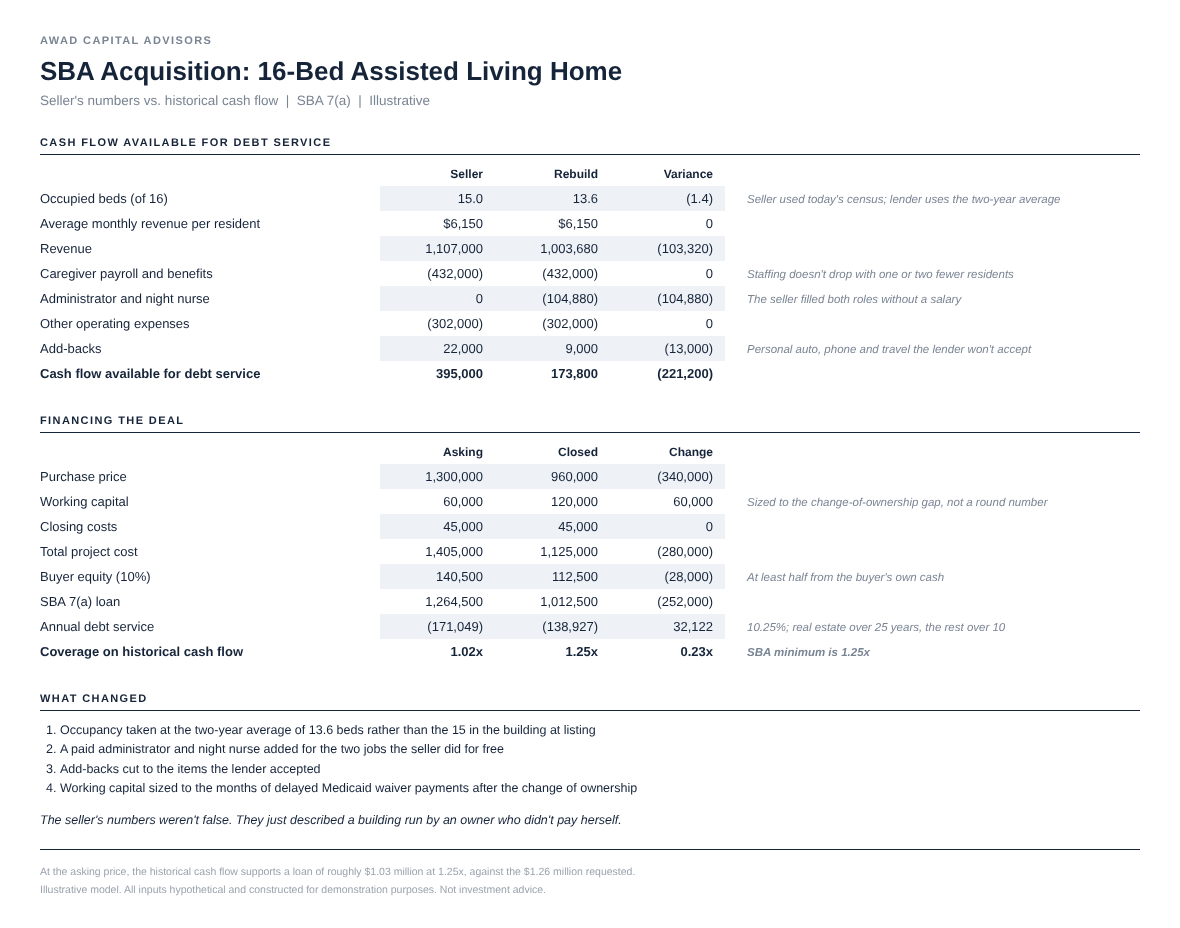
Put together, $395,000 of cash flow became $173,800, and coverage at the asking price went from 2.31x to 1.02x, against a 1.25x minimum. At $1.3 million, the historical numbers supported a loan of about $1.03 million against the $1.26 million she needed.
The cash nobody budgeted
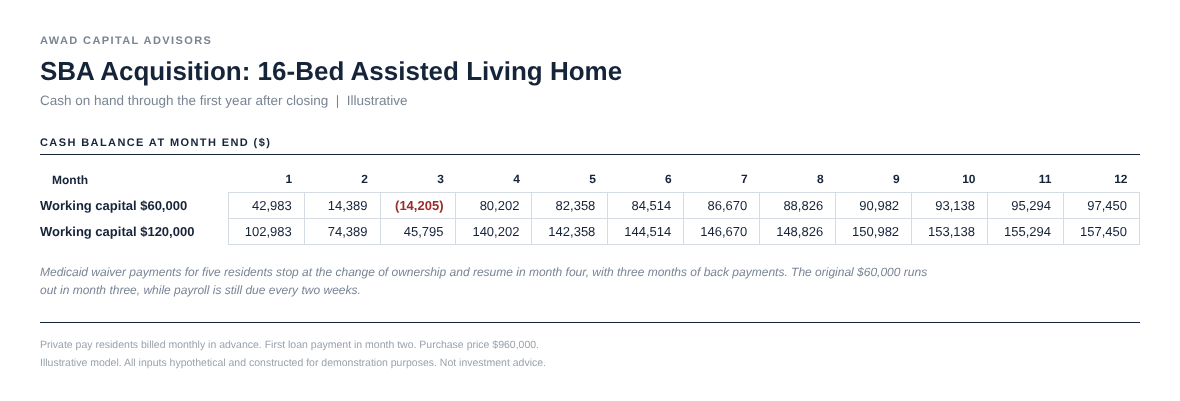
Five of the residents were on a Medicaid waiver. After a change of ownership, those payments stop until the new operator is enrolled, and the model assumes that takes three months. The deal budgeted $60,000 of working capital. With private pay coming in and payroll going out every two weeks, that runs out in month three, a month before the waiver money starts again.
Where it landed
We took the rebuilt numbers back to the seller. Her broker pushed back on the administrator salary until the lender's own analysis came back with the same adjustment. The deal closed at $960,000, with $120,000 of working capital in the loan, which put coverage at 1.25x on the historical numbers.
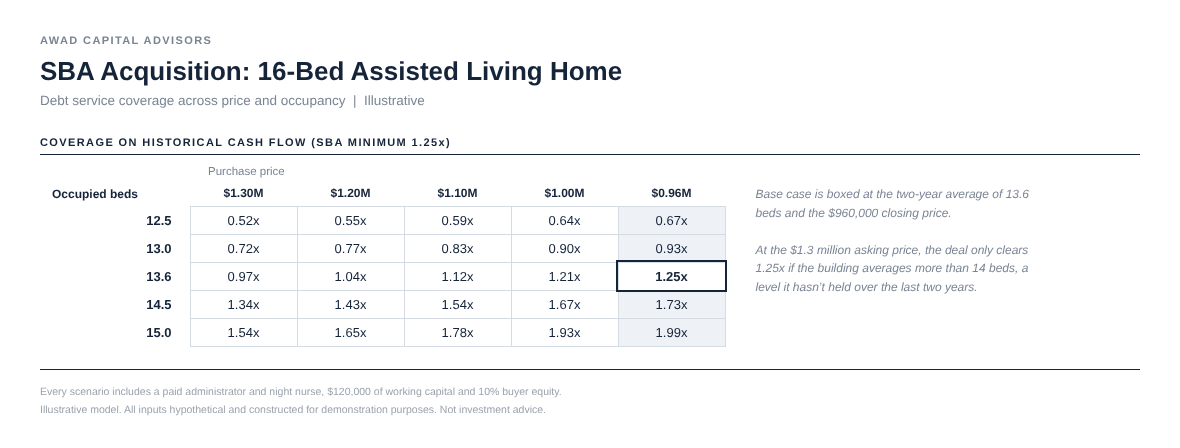
The grid is what moved the seller. At $1.3 million, the building has to average more than 14 residents to clear the SBA's minimum, and it hadn't done that in two years. The price wasn't wrong because the seller was greedy. It was wrong because the financials described a business that came with a free administrator and a free night nurse, and the buyer wasn't getting either one.