Rebuilding the Underwriting
Illustrative example. Figures are hypothetical.
What was on the table
184 units, Class B, Southeast secondary market. Sponsor had it under LOI at $22.1M, about $120k per door, 6.7% cap going in. Plan was standard value-add: renovate 140 units, push rents $185, sell in year five.
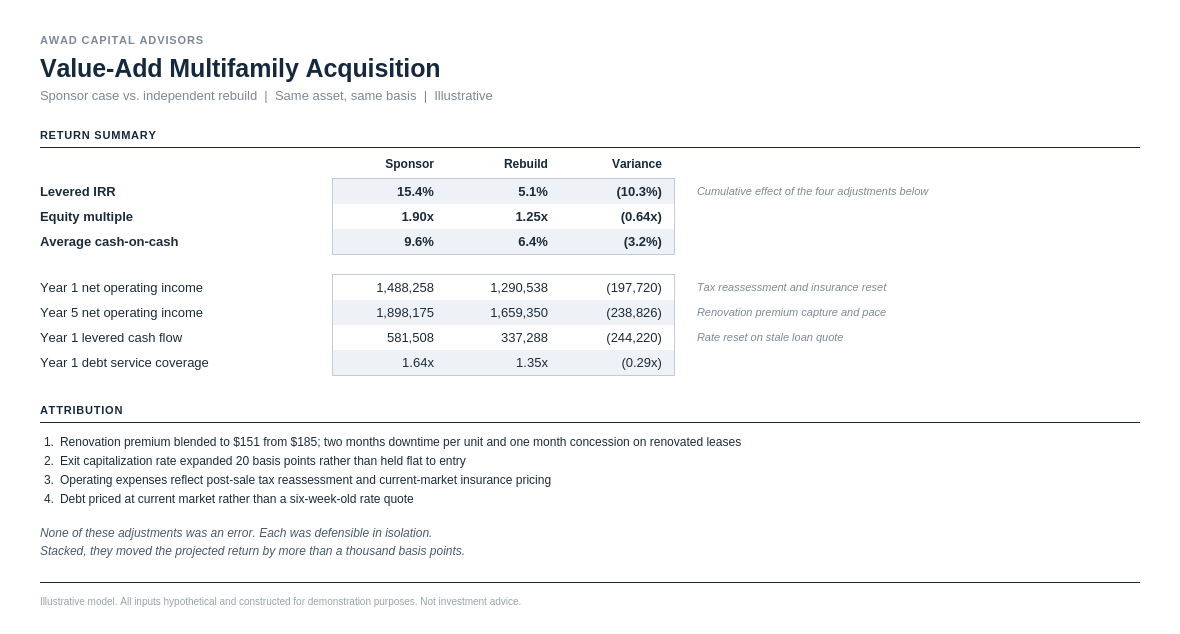
Their model showed 15.4% IRR and a 1.9x. They were three weeks from hard money with LPs already soft-circled on $8.6M.
They brought me in to rebuild the underwriting before the deposit went non-refundable.
What I found
Four things, and none of them were mistakes exactly. The $185 premium was real, but only for units getting the full scope. Their own scope sheet had about 30 of the 140 units getting partial work. Blended out, the premium was closer to $151.
Exit cap was held flat to entry. That's a bet that year five looks exactly like today, which is a bet, not an assumption. I put 20 basis points of expansion on it, which is conservative if anything.
The T12 looked clean, but the property hadn't traded in eleven years and that county resets assessed value to the sale price. That's another $310 a unit. Insurance was worse. The policy was bound before the last two renewal cycles in that state and current quotes came back 34% higher. Between the two, year one NOI dropped almost $200k.
The rate in the model was six weeks old and 30 bps inside where it was actually pricing.
Where it landed
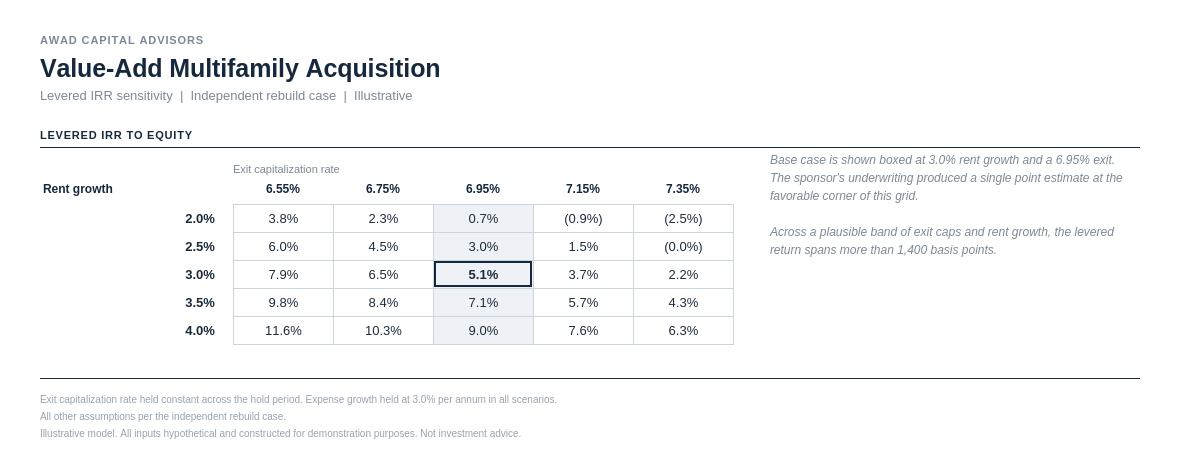
15.4% became 5.1% and the multiple went from 1.9x to 1.25x. They took it back to the seller, couldn't get the price down far enough, and let the LOI go.
The thing that actually ended the conversation was the sensitivity grid. Across a normal range of exit caps and rent growth, the deal ran anywhere from negative 2.5% to 11.6%. Their model had shown one number.
Every one of those four assumptions was defensible on its own, and together they moved the return more than a thousand basis points. That's the version I see most often, where the math is right and the answer is wrong because everyone in the room has some reason to want it to work, whether that's a broker and a lender who only get paid at closing or a sponsor who already told his LPs a number.