A Refi That Couldn't Be Sized
Illustrative example. Figures are hypothetical.
What was being marketed
A sponsor was raising $12.6M for a 220 unit value-add deal at $34.5M, projecting 13.9% to LPs over five years. What made it interesting was the refinance: at the end of year three they'd pull cash out and hand back about half of everyone's capital, and you'd still keep your full position. The materials put it at 48% of capital returned. A prospective LP brought me in to look at the model and the partnership agreement before the subscription deadline.
Sizing the refinance
The refi was carrying the whole thing, and once you strip it out what's underneath is an ordinary deal. They'd sized it in one line: value the property at a 5.50% cap, apply 70% LTV, subtract what's outstanding, which gets you $6.06M. But lenders run three tests and lend against whichever comes back lowest, and this model had only run one. Coverage was the binding constraint at $23.2M, not the $28.8M they were using. After paying off the existing debt, actual proceeds came to about $577K, which is 4.6% of investor capital rather than 48%.
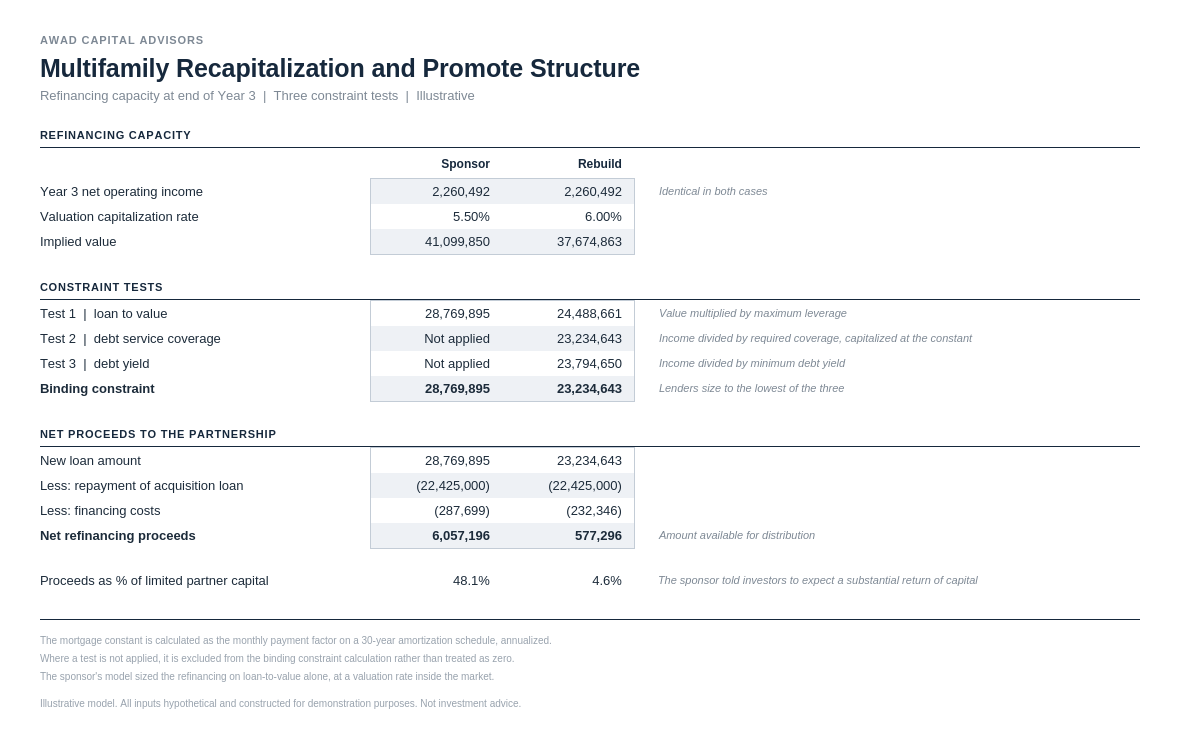
Three things stacked to get them that far off. The 5.50% cap was 50 bps inside where comps were trading. No coverage test was run, and at that leverage coverage is exactly what binds. And they'd assumed interest-only where agency pricing requires amortization, which shrinks the loan further.
Who absorbs the difference
That explains why the money isn't there. The partnership agreement explains who absorbs it. The pref didn't accrue, so when years one and two came up short, those shortfalls just vanished at year end rather than carrying forward the way most people assume, which is close to $450K of investor economics erased by a drafting decision nobody flagged. And the promote came ahead of return of capital, meaning that under the sponsor's own projections the GP collected $1,792,800 in year three at a point when investors still had every dollar outstanding.
Rebuilt, LP IRR came in at 10.4% instead of 13.9%, and GP promote dropped from $2.01M to $852K. But the number I'd put in front of an investor is that $1,792,800 paid out before anyone got their capital back. Under a normally drafted waterfall it's zero.
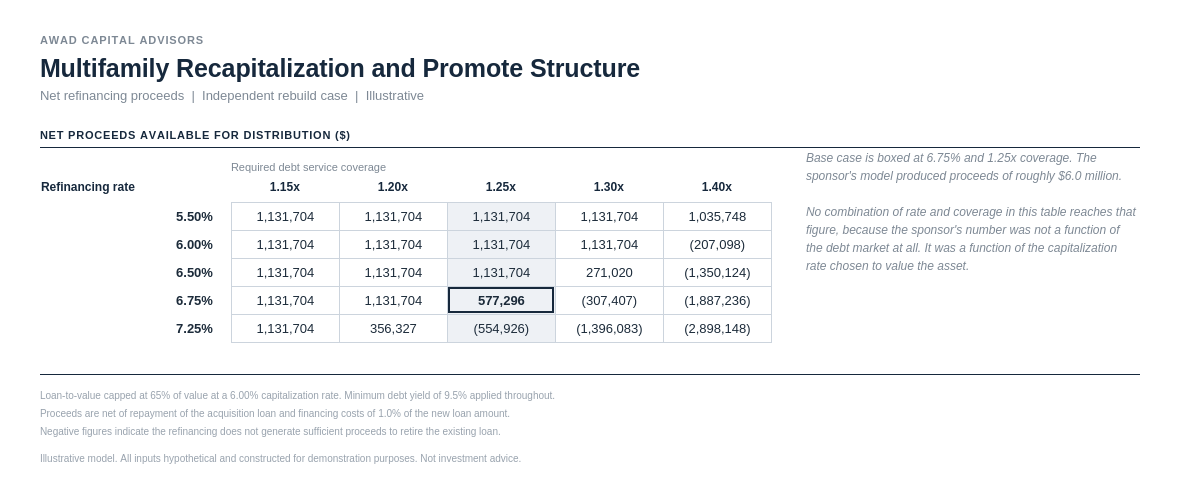
I ran refinancing proceeds across every plausible combination of rate and required coverage, and the highest figure anywhere in that table is $1.13M, sitting in the corner where rates are lowest and coverage loosest. Their $6.06M doesn't appear anywhere in it, and it can't, because it was never a debt market number to begin with. It came out of the cap rate they chose to value the property with, which means no rate environment produces it.
The first two findings are underwriting and they change what the deal returns. The last two are drafting, and they change who eats the difference, which is quieter and harder to catch, because a non-accruing pref and a promote ahead of capital both read as unremarkable to someone skimming a subscription doc at the end of a long week. A model tells you what happens if things go the way you drew them up. The partnership agreement tells you what happens when they don't.
My client didn't invest. The sponsor later rewrote the waterfall with an accruing pref and full return of capital ahead of promote, and closed the raise on those terms.